The journal
How to Keep a Sourdough Loaf Fresh for Days
Cut side down on a board, never in the fridge, and into the freezer on day three — and why each of those works.
The short version
Everything this article has to say is already printed on our sourdough page, in three short sentences:
Keep it cut side down on a board for two days, or in a linen or paper bag. Never the fridge, which stales bread faster than the counter does. Slice and freeze what you will not eat by day three, and toast it from frozen.
The rest of it is why. Advice you understand is advice you can bend — to a kitchen that runs warm, to a household of one, to a loaf you forgot about until the weekend.
Start with the loaf you will finish
The easiest loaf to keep is the one you eat. Our country sourdough is a 900 g round loaf, at $10.00, and for a small household that is a good deal of bread to get through. So there is a second line on the menu, half a country sourdough, at $5.50: the same loaf, cut in half at the counter for a household of one or two.
Half a loaf starts its life at home with a cut face, and that matters for everything below. A whole loaf is closed on every side by its crust. Once it is cut, it has one open side, and the open side is the one that dries.
Cut side down, on a board
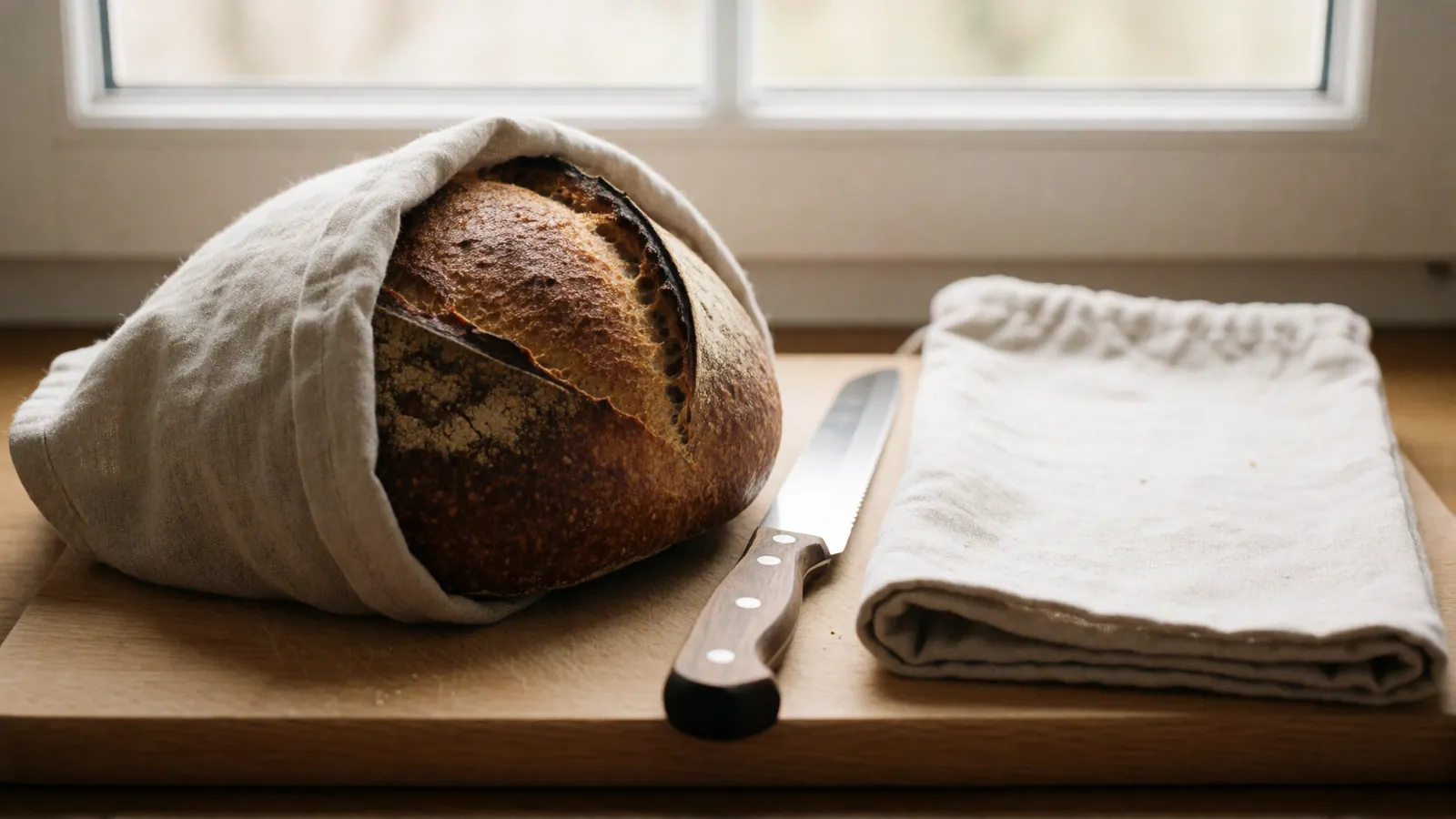
This is most of the trick, and it costs nothing. Stand the loaf on its cut face on a wooden board, and the one open side is pressed against the wood while the crust covers everything else. Cut your next slice, turn the loaf back over, and it stays closed until you want it again.
The crust is taken dark on purpose, because that is where the taste of a long bake is. For the first two days that crust is also the loaf’s wrapping, which is why the advice starts with a board and not a bag. If the board is needed, or the kitchen runs warm, a linen or paper bag does the same job for the same two days.
Never the fridge
The fridge feels like the careful choice, and it is the wrong one. It stales bread faster than the counter does, so a loaf put away cold to make it last is a loaf that is finished sooner.
From our side of the counter there is something backwards about this. The night before it was baked, that loaf sat in its basket in the cold room at about 40°F, and the cold was doing it good: the long, cold rise is where the flavour of a country loaf comes from. Cold is the right place for a dough that is still rising. Once the loaf is baked, the right place is the counter.
Day three: slice it, then freeze it
By the third day the job is no longer keeping the loaf but saving what is left of it, and that is the freezer’s job. The instruction is precise for a reason: slice first.
A whole frozen loaf has to come out of the freezer whole, and then it is a whole loaf again, with exactly the problem it went in with. Frozen slices come out one at a time. “Toast it from frozen” means what it says — there is no need to thaw a slice first.
The freezer is also half the reason for one of the larger lines on the menu. Six country sourdough loaves are sold as six 900 g loaves, for a party or a freezer, and they need one day’s notice: a large bread order, shaped the afternoon before for your pickup morning.
Other loaves keep differently
Everything above is about the country loaf. The other breads on our shelf are built differently, and each keeps in its own way.
- Baguettes. Eat it the day you buy it. A day-old baguette wrapped in a damp cloth and put in a hot oven for five minutes comes back most of the way; a two-day-old one is breadcrumbs.
- Rye bread. Rye keeps better than any other bread here. Wrapped, on the counter, the pumpernickel is good for five days and the seeded rye for three.
- Brioche and challah. Both stay soft for two or three days in a bag. Stale brioche and challah are what French toast and bread pudding are for.
- Croissants. A croissant is best within four hours. To revive one the next day, five minutes in a hot oven, never a microwave.
If you shop once for several days, that list is the plan: the baguette and the croissants on the day you buy them, the country loaf over the next two, and the pumpernickel towards the end of the week.
What happens to a loaf nobody bought
Loaves left at closing are sold the next morning on the end shelf, marked as the day before’s. That way you know which one you are buying, and everything in this article applies to it from the moment you get it home.
More from the journal
How pickup works. Every pickup time is a fifteen-minute window, and each window takes a limited number of orders, so the morning's orders are spread across the counter rather than arriving in one queue. Same-day orders can be collected from about forty-five minutes after you order.
A country loaf, or half of one
Country sourdough, $10.00, or half, $5.50. No notice needed for a single loaf — choose a pickup window and pay at the counter.